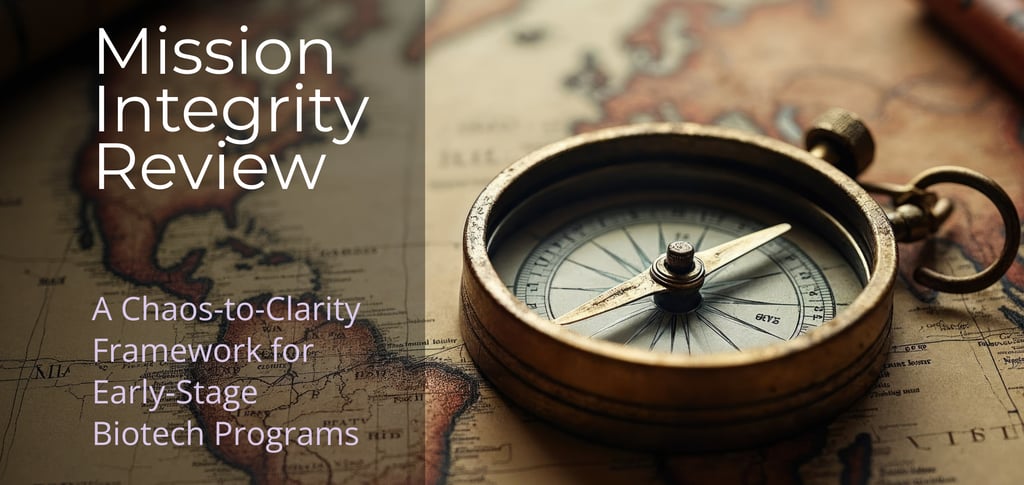
Mission Integrity Review - A Chaos-to-Clarity Framework for Early-Stage Biotech Programs
Part of the SynergyLM Chaos-to-Clarity Series, this article builds on my earlier post Chaos to Process by exploring how early-stage biotech teams can reconnect their programs to their original mission. It offers a practical framework for turning complexity into shared clarity, alignment, and focused execution at critical development milestones.
2/16/20263 min read

Early-stage biotech companies move quickly—often with small internal teams, multiple contractors, evolving science, and intense investor expectations.
In that environment, activity can easily outpace alignment.
A Mission Integrity Review is a structured process that reconnects science, strategy, and execution so every team member and contractor is working toward the same outcome.
It is especially valuable before major clinical milestones, partnership discussions, or leadership transitions - when an original plan may, for example, have been to build a broad platform, pursue multiple indications, or go public, but may now need to evolve toward a focused indication, partnership strategy, or acquisition path.
Two Layers of Mission in Biotech Programs
Early-stage biotech companies operate with two related but distinct layers of mission:
1. Company Mission – WHY the company exists
The long-term purpose or change in medicine the company aims to create.
2. Program Mission – HOW the company creates value now
The specific asset, milestone, or business objective that demonstrates the company’s approach works.
Confusion between these two layers often creates misalignment.
A Mission Integrity Review clarifies both—and ensures they remain connected.
Misalignment often begins when teams confuse the company’s purpose with the program’s proof point.
The following steps outline a structured approach for conducting a Mission Integrity Review in a practical, organized way:
Step 1 – Reconstruct the Company and Program Mission
Before planning forward, understand both the company’s founding purpose and the current program’s value-creation goal.
Company Mission
• What scientific or clinical problem was the company created to solve?
• What solution or therapeutic approach was proposed to address that problem?
• What long-term impact in patient care was envisioned?
Program Mission
• What patient population was prioritized for the lead asset?
• What key milestone was expected to demonstrate meaningful value for patients, partners, and the company (for example, Phase-2 data, platform validation, or a strategic partnership)?
Output:
->Shared understanding of both company mission and program mission.
The goal is not to produce a document, but to ensure leadership describes both clearly and consistently.
This anchors decision-making and prevents strategic drift.
Step 2 – Compare Plan vs. Current Reality
At early clinical stages, reality often diverges from early assumptions.
Questions to ask:
• Did early data change expectations?
• Has the patient population shifted?
• Are endpoints evolving?
• Has company focus narrowed or expanded?
• Has the competitive or regulatory landscape changed?
Output:
->A clear understanding of where assumptions and reality differ.
Reality may affect the program mission, the company mission, or both—and may indicate where course correction is needed.
Step 3 – Reassess Strategic Objectives in Light of Reality
After clarifying the original thesis and comparing it with current reality, leadership should ask:
“Given what we now know, what outcomes should this program actually be optimizing for?”
Early-stage biotech strategies often evolve.
An original plan to build a broad platform, pursue multiple indications, or go public may shift toward a focused indication, partnership strategy, or acquisition path.
Questions to explore:
• What outcomes were originally expected, and are they still realistic?
• What does current data suggest about the strongest path forward?
• What do investors now view as success?
• What is the most likely next inflection point—partnership, acquisition, Phase-3 funding, or platform validation?
• What capabilities must be strengthened to reach that outcome?
Output:
->Updated strategic objectives aligned with current reality.
These objectives guide trial design, resource allocation, and communication with contractors and partners.
Step 4 – Align Leadership and Governance Before Communicating
In contractor-heavy biotech organizations, alignment cannot be assumed—especially when chiefs, advisors, or functional leaders are contractors.
In addition to internal leadership, key governance groups should review and support the strategic objectives:
• Board of Directors
• Clinical Advisory Board
• Key investors
• Regulatory advisors
• Strategic partners (if relevant)
Each stakeholder group should be able to answer:
• Do we support these objectives?
• What risks are acceptable?
• What assumptions need validation?
• What resources are required?
Output:
->Documented alignment across leadership and governance stakeholders. - Only after this step should priorities be communicated broadly to CROs, vendors, and contractors.
This prevents rework, conflicting guidance, and loss of confidence later in the program.
Step 5 – Transition from Alignment to Execution Planning
Once leadership and governance stakeholders are aligned on company mission, program mission, and updated strategic objectives, the Mission Integrity Review is complete.
The next step is a separate execution-planning phase, where that shared clarity is translated into detailed operational plans.
This typically includes:
• Integrated program roadmap and timeline
• Updated development or trial plans
• Contractor scope alignment
• Resource and budget planning
• Decision cadence and reporting structure
These activities are intentionally treated as a follow-on effort, because execution planning built on unclear objectives only accelerates misalignment.
Output:
->A clearly defined execution-planning phase grounded in aligned objectives.
This ensures that the roadmap reflects shared strategy—and that teams move forward with confidence rather than assumption.
In Summary
In early-stage biotech, misalignment - not science - is often the greatest risk.
A Mission Integrity Review helps leadership teams clarify both company mission and program mission, assess how reality has changed the path forward, and align stakeholders on the objectives that matter most.
Only after that alignment should detailed execution planning begin.
This approach reduces duplicated effort, improves contractor coordination, and supports confident decision-making at critical milestones—helping teams move from noise to clarity and from clarity to progress.
SYNERGYLM, LLC
liz.michael@synergylm.net
7901 4th St. N #25825
St. Petersburg, FL 33702
© 2025. All rights reserved.