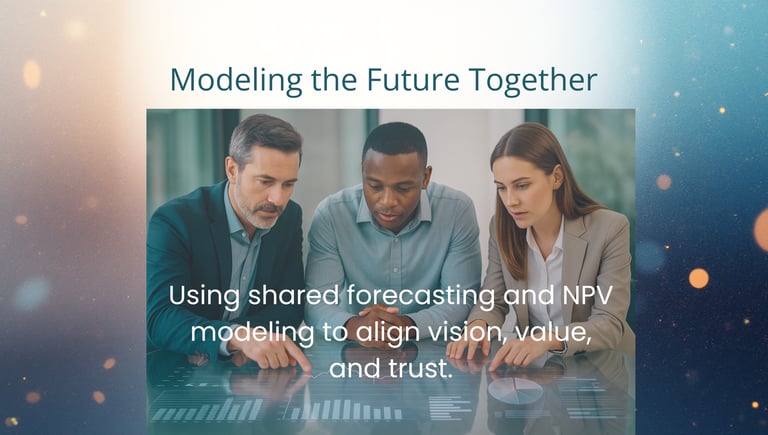
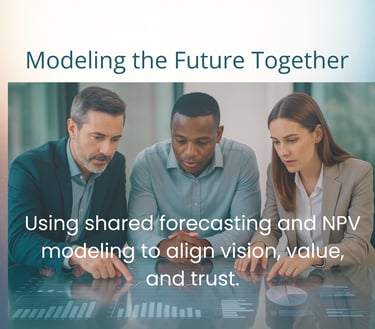
Modeling the Future Together: NPV as a Tool for Trust
Early-stage teams don’t fail for lack of innovation—they fail for lack of alignment. This post explores how shared forecasting and NPV modeling turn scattered assumptions into clarity, confidence, and trust.
10/28/20254 min read
In early-stage development, most teams can tell you what they’re building. Far fewer can tell you, with confidence, how it becomes a business.
That gap is where momentum dies.
Great science, elegant engineering, even early clinical signal — none of that guarantees a product will earn its way into the market, get adopted, and generate meaningful revenue. And it’s not because the idea isn’t good. It’s because the story behind the numbers hasn’t been built, pressure-tested, and shared.
This is where forecasting and NPV modeling actually matter.
Not because investors demand a spreadsheet (they do). Not because finance wants it for the deck (they do). But because the act of building an NPV together is one of the fastest ways to align partners around reality, risk, and reward.
It’s not just math. It’s trust.
The myth of the “magic spreadsheet”
There’s a myth in our industry that if you just plug in market size, adoption rate, and price, the model will spit out an answer and tell you whether something is “worth it.”
That’s not how it works.
NPV (Net Present Value) isn’t fortune-telling. It’s a structured way of asking hard questions:
What problem are we actually solving, and for whom?
Who pays for it, and through what channel?
How fast can we reasonably earn adoption — not in a perfect world, but in this one?
What’s it going to cost us to get there?
When those questions aren’t answered out loud, each stakeholder quietly fills the silence with their own assumptions.
R&D assumes the tech will be valued for its elegance.
Commercial assumes the market will convert faster than it actually will.
Leadership assumes pricing power that the channel may never allow.
And external partners assume there’s a plan for scale.
On paper, the project still looks exciting. In reality, those mismatched assumptions are already setting up friction, delays, and in some cases, expensive pivots.
The model itself isn’t the problem. The isolation is.
NPV as an alignment tool
When it’s done well, forecasting is less about predicting revenue and more about surfacing beliefs.
For example: let’s say two partners are collaborating on a novel device or digital health solution. One group believes hospitals will adopt quickly because the clinical case is strong. The other group quietly thinks the sales cycle is 9–12 months per account and requires hands-on onboarding.
That’s not a minor difference. That’s the difference between cash-positive in Year 3 and cash burn through Year 5.
If you never bring those assumptions into a shared model, you don’t see the misalignment until you’re standing in it.
But if you sit down together, build scenarios, and walk line by line — pricing, adoption curve, cost to educate the customer, regulatory timing, reimbursement friction — something powerful happens:
Everyone starts owning the same future.
Engineering can see why certain features matter commercially.
Commercial can see why certain technical milestones drive valuation.
Leadership can see where the real inflection points are — and what has to be true to hit them.
Partners stop speaking in generalities (“big opportunity,” “huge market”) and start speaking in specifics (“a 6% adoption assumption in targeted surgical centers by Year 2 means we need X reps and Y onboarding resources”).
This is the real value of the exercise. Not just the number at the bottom of the sheet. The shared understanding that builds around it.
Modeling the future together
The most effective teams don’t treat an NPV as a one-time deliverable. They treat it as a living conversation.
Here’s what that looks like in practice:
1. We model together, not in silos - Instead of finance building a forecast in isolation and sending it around for “comment,” the groups who will actually have to execute — product, clinical, regulatory, marketing, partners — are in the room shaping it.
2. We test reality, not optimism - We don’t ask “How big could this be in the absolute best case?” We ask “What would have to be true for us to actually earn this revenue — and who is responsible for making that happen?”
3. We scenario fast - If we change the channel (direct hospital vs distributor), what happens? If pricing is pressured down 15%, what breaks first? If regulatory adds six months, do we have enough runway? When teams can explore those branches quickly, they make smarter resource decisions earlier.
4. We clarify the ‘why now’ story - This step matters especially for external development partners and investors. A grounded model gives you the credibility to say: “Here’s not just why the product matters — here’s how it becomes a business that can sustain itself.”
That last point is where a lot of early-stage programs struggle. The science is impressive. The prototype works. But when someone asks, “Walk me through how this pays off,” the answer gets vague.
That vagueness is a red flag for partners.
On the other hand, when you can walk someone through a believable path to revenue — including cost to launch, ramp time, headcount assumptions, pricing pressure, regulatory timing — it does more than de-risk the opportunity.
It builds confidence in you.
This is about credibility, not perfection
No forecast is perfect. Every NPV you build today will get revised six months from now. That’s normal.
What’s not optional anymore is clarity.
If you’re developing a product, trying to prioritize which program to advance, or asking a strategic partner to invest resources alongside you, you need more than “We think the market opportunity is huge.”
You need to be able to say, and show:
Here’s how this becomes revenue.
Here’s what it will realistically take.
Here’s where the risks live.
Here’s why it’s still worth doing.
That is how you earn trust early — and keep it when things get hard later.
When partners build the model together, they’re not just calculating potential.
They’re defining the relationship.
SYNERGYLM, LLC
liz.michael@synergylm.net
7901 4th St. N #25825
St. Petersburg, FL 33702
© 2025. All rights reserved.